

How To Draw A Wave In Steps
Are you daydreaming nearly a perfect day of surfing and endless rides? Here's a simple pace-by-pace tutorial on how to draw an ocean moving ridge.
Acquire how to sketch, draw, and pigment a proficient-looking wave from beginning to cease. You don't need to be an art educatee or a professional artist to
Get set to produce an impressive hand-drawn moving-picture show of a moving ridge beingness ridden by a lone surfer in a far, distant tropical surf break.
The following drawing lesson for beginners of all ages will plow you into a surf artist in less than five minutes.
All you need is a pencil or a pen, and a white sheet of paper or a notebook.
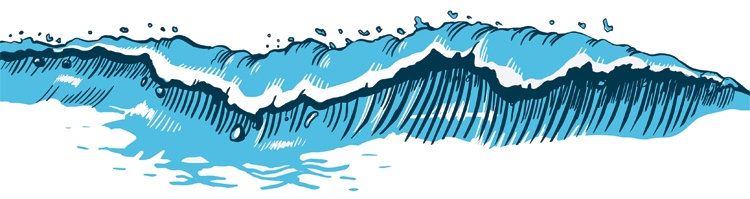
Bob Penuelas and the Wilbur Kookmeyer Legacy
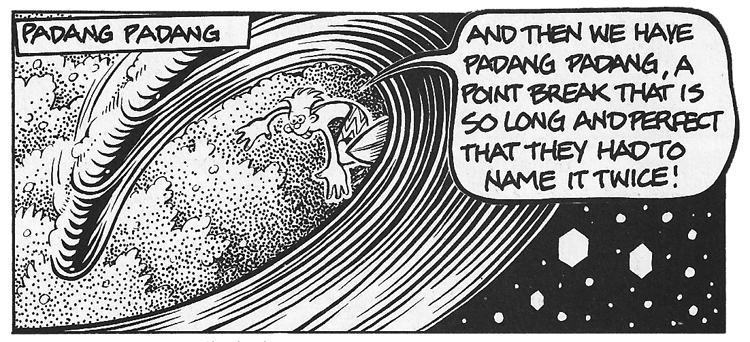
In 1985, Bob Penuelas created a drawing character called Wilbur Kookmeyer every bit a supporting character in the comic strip "Maynard and the Rat," published in Surfer Magazine from 1980 to 1987.
Penuelas was born and raised in San Diego, California. His begetter taught him how to draw when he was but iv years onetime.
The artist has always been attracted to surfing and fine art, and so he spent a lot of time doodling dreamy surfing waves during loftier school classes.
Penuelas' impressions of Southern California and its unique surf civilisation are the result of endless hours spent surfing and hanging out at the embankment.
Wilbur, the kooky trivial surfer, clicked with the readers and shortly spun off to star in his comic strip.
It's a satirization of the pseudo-surfers that started showing up at the beach in the mid-1980s wanting to look cool and mimic the surfing lifestyle without even knowing how to surf.
As an illustrator, Bob Penuelas drew thousands of waves, from super hollow cylinders and heavy closeouts to mushy rollers, and perfect corduroy lines stretched the horizon.
They're arguably the most recognizable hand-drawn waves ever, alongside Katsushika Hokusai's "The Smashing Moving ridge off Kanagawa."
Drawing Waves 101
Take Bob Penuelas' advice and start sketching perfect waves breaking and peeling perfectly down the line.
Follow the instructions closely and restart or erase if you retrieve you tin meliorate your first take.
The basic steps of drawing waves will then permit you to create ocean rollers from different angles using the fundamentals of perspective.
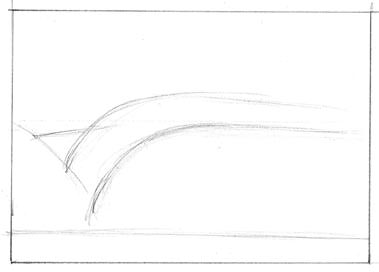
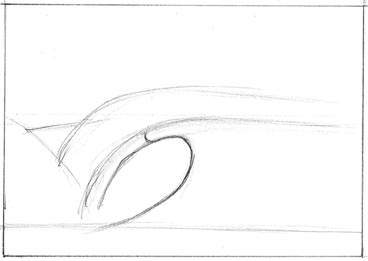
1. The Crest
Sketch a simple shape of the crest, curl, cream, spray, and the flats, i.e., the trough or base of the wave.
The fox is to start drawing a horizontal line - the top of the wave - and then smoothly slope it down.
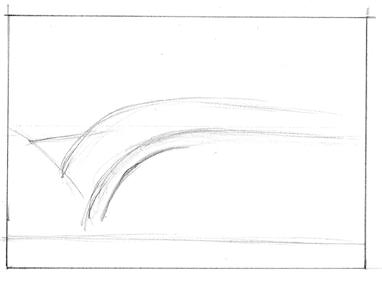
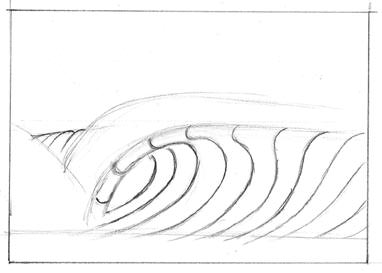
2. The Butt
Depict a C-shaped curved line parallel to the high scroll line to create a falling lip.
Then, create a menstruation line that starts on the higher part of the sloped line and curves around down to the trough to create the wave's face and the tube.
Add more than flow lines making certain they go less steep every bit they move away from the pocket toward the shoulder of the wave.
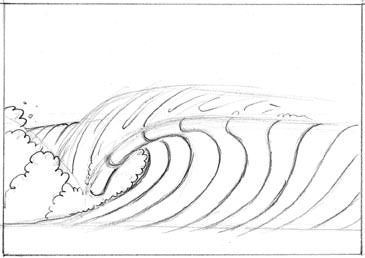
three. The Spray and Whitewater
Time to describe the lip exploding on the surface of the water.
Add a cloud-like bubble that gets bigger as it moves away from the breaking moving ridge and a pocket-size foam ball within the barrel.
Draw a few thin lines coming out of the tube to illustrate the spray spitting from the crimper wave.
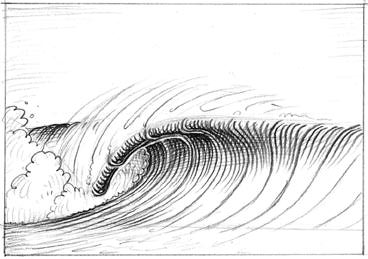
4. The 3D Result
Adding shading to the wave will get in look tridimensional.
So, draw small and gradually darker profile lines every bit they get closer into the tube and beneath the falling lip.
When fine parallel lines are drawn closely together - a technique called crosshatching - they create the illusion of texture, shade, and depth in the wave.
Use a precipitous eraser to "draw" a thin white line under the lip to separate it from the face of the moving ridge.
Perspectives, Moving ridge Types and Surfers
Now that you've successfully drawn your get-go moving ridge, it's time to have a look at how you can add surfers, create different types of waves, and fifty-fifty diversify the drawing perspective.
Surfers tend to expect at waves from several angles.
The virtually common perspectives are the paddler's view, the in and out of the tube view, the pier view, and the aerial view.
The trick is to focus on the horizon line and modify the imaginary vanishing points to sketch a variety of different waves.
Try lowering or raising the horizon line and moving your vanishing points right or left.
In the end, add a surfer into the mix, color the sea with a few shades of bluish, and light upwards those skies with stunning dusk tones.

Source: https://www.surfertoday.com/surfing/how-to-draw-waves
Posted by: ludlumtrabut.blogspot.com
0 Response to "How To Draw A Wave In Steps"
Post a Comment